

Seven Oceans Expeditions · Field Guide · Volume 5
Polar Diving
Essentials
Cold water is a problem you solve, not a wall you stop at.
About This Guide
“I’d never dive in water that cold.”
We hear it all the time, from new divers and experienced ones alike.
Most divers learned in the tropics, in water around 27 to 29°C (80 to 85°F), in a thin wetsuit or none at all. Water at 0°C (32°F) sounds like something to avoid.
It isn’t. A drysuit, the right undergarments and reliable equipment are all you need. Polar diving isn’t about toughness. It’s about readiness.
Polar diving is diving near the poles: north of the Arctic Circle or close to it, or south of the Antarctic Circle. It’s also shorthand for cold-water diving. “Cold” is relative, but in polar diving it generally means water from around 0°C (32°F) up to 3 to 4°C (38 to 40°F).
Salt water can get colder than fresh water before it freezes. In the sea, you may dive water as cold as −2°C (29°F). Fresh water that cold has already turned to ice or slush.
Because what you’ll see is like nothing in the tropics: different marine life, geology and light, and visibility that behaves differently. Above the water, it’s just as different. In places like Greenland, you dive beneath towering mountains, in water that is peaceful and never crowded. It feels special, and you share a bond with your fellow divers that is hard to find anywhere else. Between dives, there’s time to take it all in.

Learning to dive outside tropical and temperate water opens up an entirely new universe of diving. There’s something freeing about that. Greenland, Norway, Antarctica, Iceland, Canada: with the right gear, you can dive almost anywhere in the world.
Imagine you’ve lived your whole life on a tropical island and never seen snow. You watch people skiing in the Alps and wonder how anyone survives that cold.
Anyone who skis knows the answer: you dress for it. Polar diving works the same way.
Four pieces of equipment keep you warm: your drysuit, undergarments, dry gloves and hood.
The Drysuit
A drysuit doesn’t keep you warm. It keeps you dry, keeping water off your skin. Warmth comes from what you wear underneath.
Undergarments
These do the real work. There are two approaches:
A full-length, overall-style insulated suit, commonly made of Thinsulate around 420 g. Put on a thin base layer, slip into the bodysuit, then put your drysuit on over it. For polar water, this is often all you need.
A base layer, a mid layer and a heavier outer layer, usually soft or high-density fleece. Layering lets you go from polar water to temperate water and back without buying a different bodysuit for each. A suit rated for polar water can be too warm at 10°C (50°F), especially at the surface on a warm day.
Dry Gloves
Like the drysuit, dry gloves keep your hands dry, not warm. They’re silicone or latex gloves that attach to your drysuit with a ring system, so you’ll need a ring system that fits your drysuit. Underneath, wear one or two layers at most: a merino wool or fleece liner. Keep gloves and liners from getting too bulky. You’ll already lose some dexterity, so practice handling your torch and other equipment before the trip.
Feet
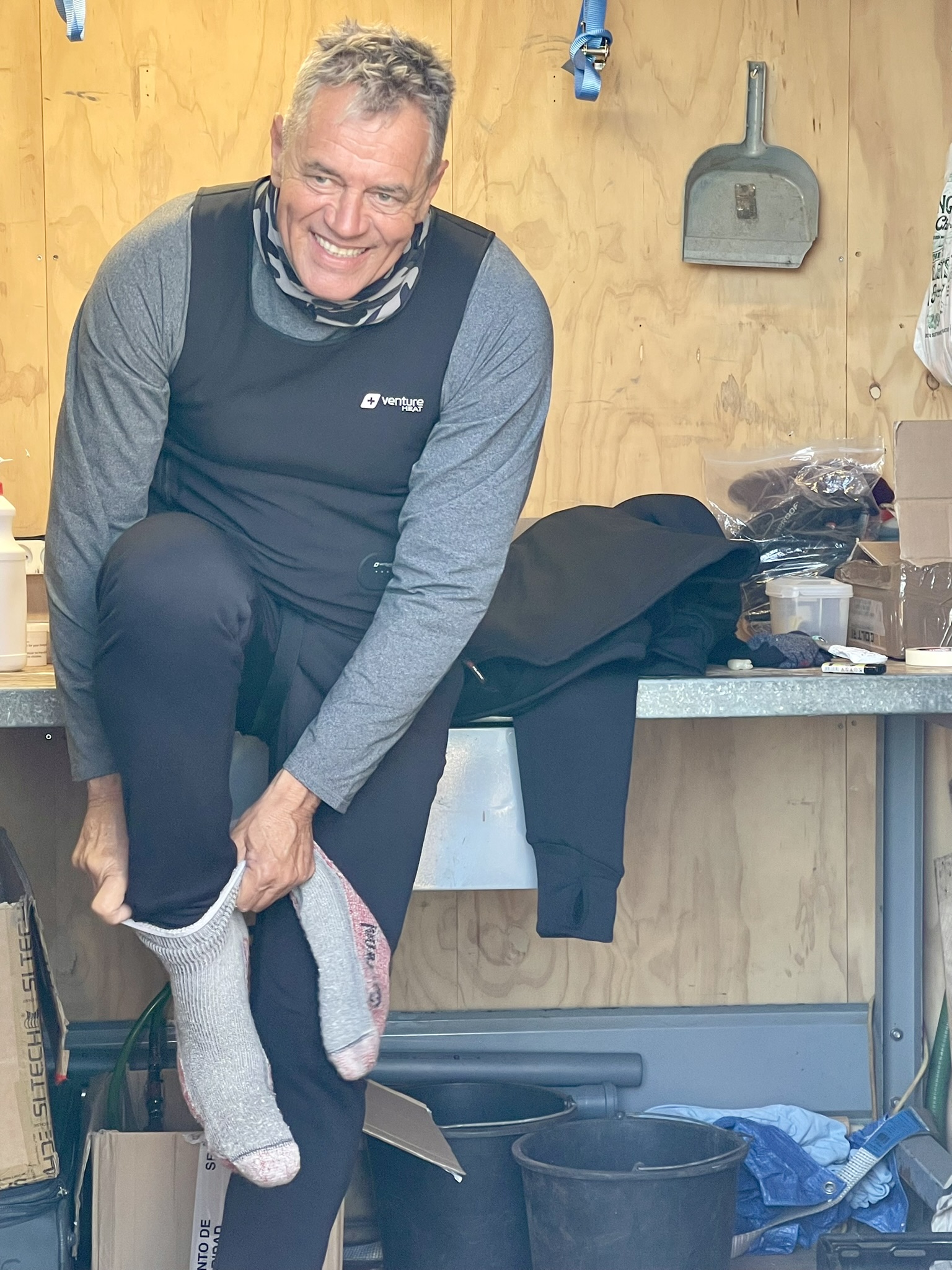
Depending on your drysuit, you’ll have attached boots or separate rock boots. Either way, wear a thin wicking sock under a thicker merino or insulated sock, and leave room in the boot.
Moving Warm Air to Your Hands and Feet
That room matters. When your fingertips or toes start to feel cold, add a little gas to your drysuit and let it move into your gloves and boots. The effect is almost instant. It’s one of the simplest ways to regulate your temperature underwater.
The Hood
If you dive a 3 or 5 mm hood, move up to a 7 or 8 mm hood. Thicker hoods exist, but 7 to 8 mm is plenty.
Heated Undergarments
Many cold-water divers use a heated vest or heated undergarment. It isn’t necessary, but it helps on dives longer than about 60 minutes, or if you tend to get cold.
- Use heat toward the end of the dive, generally the last 20 to 30 minutes, so you surface warmer than you started.
- Check your battery before you fly. Airlines limit lithium battery size: spares go in carry-on only, and batteries over 100 Wh need airline approval. Confirm with your carrier.
The key to polar diving is not to rush. Rushing leads to frustration, then anxiety, and to overheating at the surface when the air is warm and you’re in full undergarments. None of that makes for good diving.
Polar expeditions are built for this pace. We usually dive twice a day, sometimes once, with a couple of hours or more in between. Use the time.
- Get warm and dry. Undergarments are usually a little damp after a dive. Change into dry, warm clothes and hang your undergarments to dry for the next dive.
- Warm up from the inside. Hot drinks and a snack with your team.
- Debrief. Talk through the dive, log what you saw and make any changes to your gear.
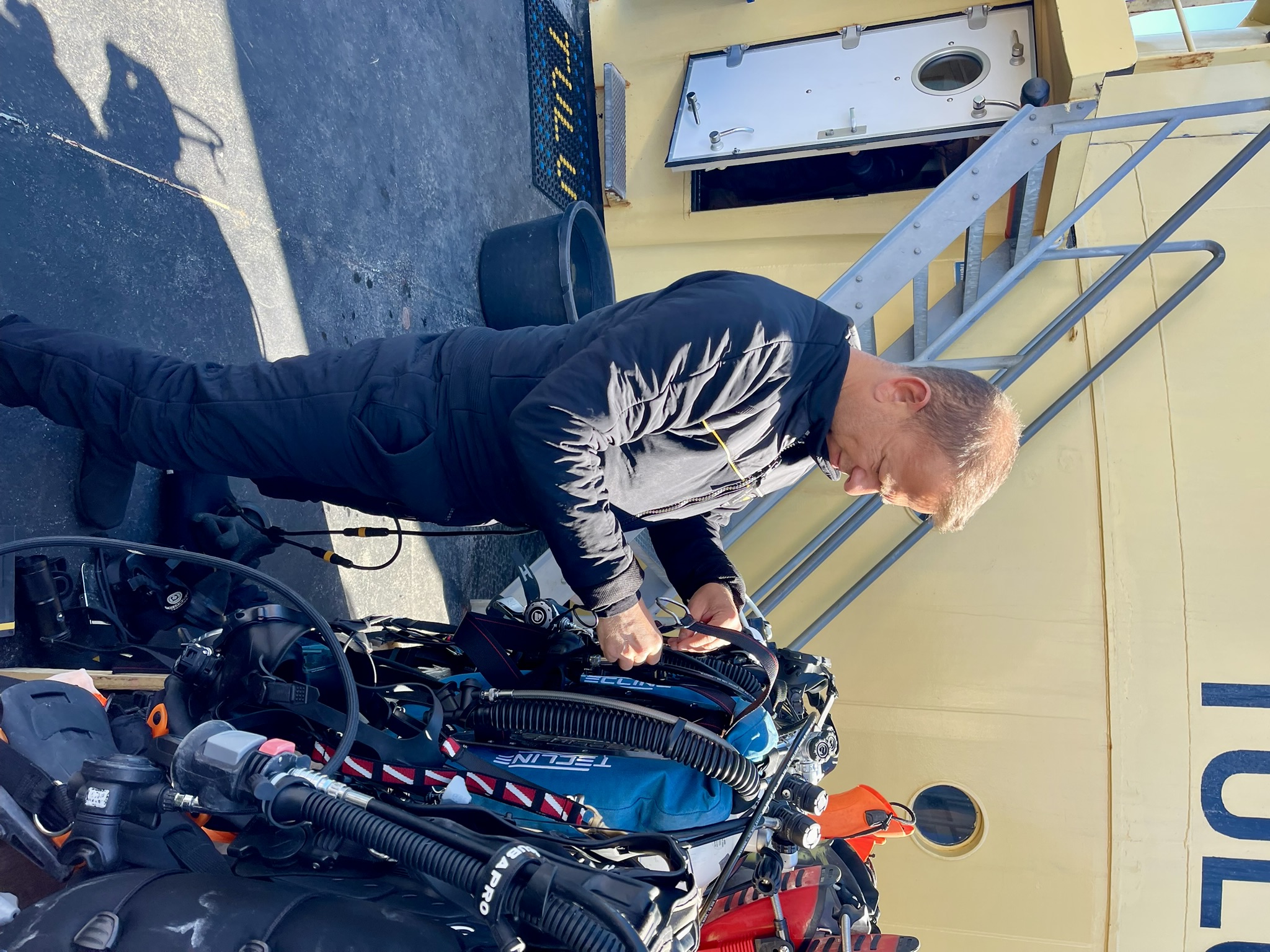
- Be methodical. Assemble and put on your gear in the same order every time.
- Have your buddy check you. Hoses routed correctly and not tangled, valves open, everything where it should be.
- Check that you have everything. Torches, SMB and anything else you’re taking on the dive.
People always ask what it feels like when you first get in.
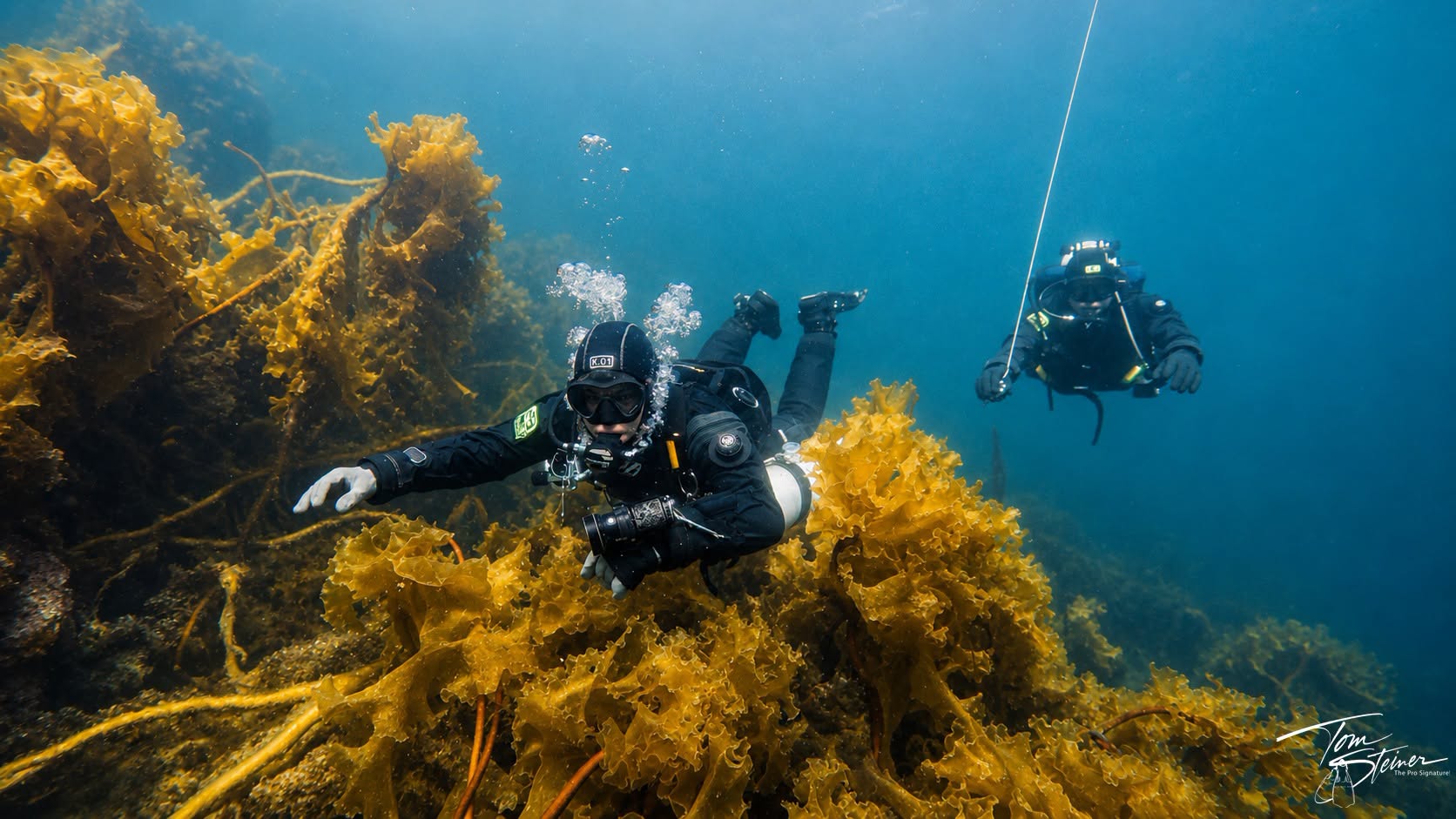
Your body feels fine. The only cold you feel is on your face, the small area between your mask and your hood. The first time, it’s exhilarating. For most people, the sensation fades within seconds, for some a few minutes. Then you’re just diving, focused on everything around you.
More Bulk
Undergarments make you bulkier, so things move. Your inflator, dump valve and D-rings may sit an inch or two from where your hands expect them. After months in tropical water, I’ll reach to clip off my torch and find the D-ring isn’t quite where it was. Expect it, practice it, and don’t get frustrated.
More Weight
Extra undergarments mean more buoyancy, so you’ll need more lead or weight. On a polar dive, that can be 12 to 15 kg (26 to 33 lb) with a 12-liter steel cylinder and a 2.7 kg (6 lb) steel backplate.
Don’t fret. Most of it usually goes on a weight belt, though you can distribute it elsewhere if you prefer. With a drysuit and full undergarments, a weight belt stays secure and is far less noticeable underwater than you’d think.
A standard wing or BCD with 14 to 16 kg (30 to 35 lb) of lift is generally enough for polar diving.
You can dive almost any configuration you’d dive elsewhere. On our 2027 expeditions, there are three options:
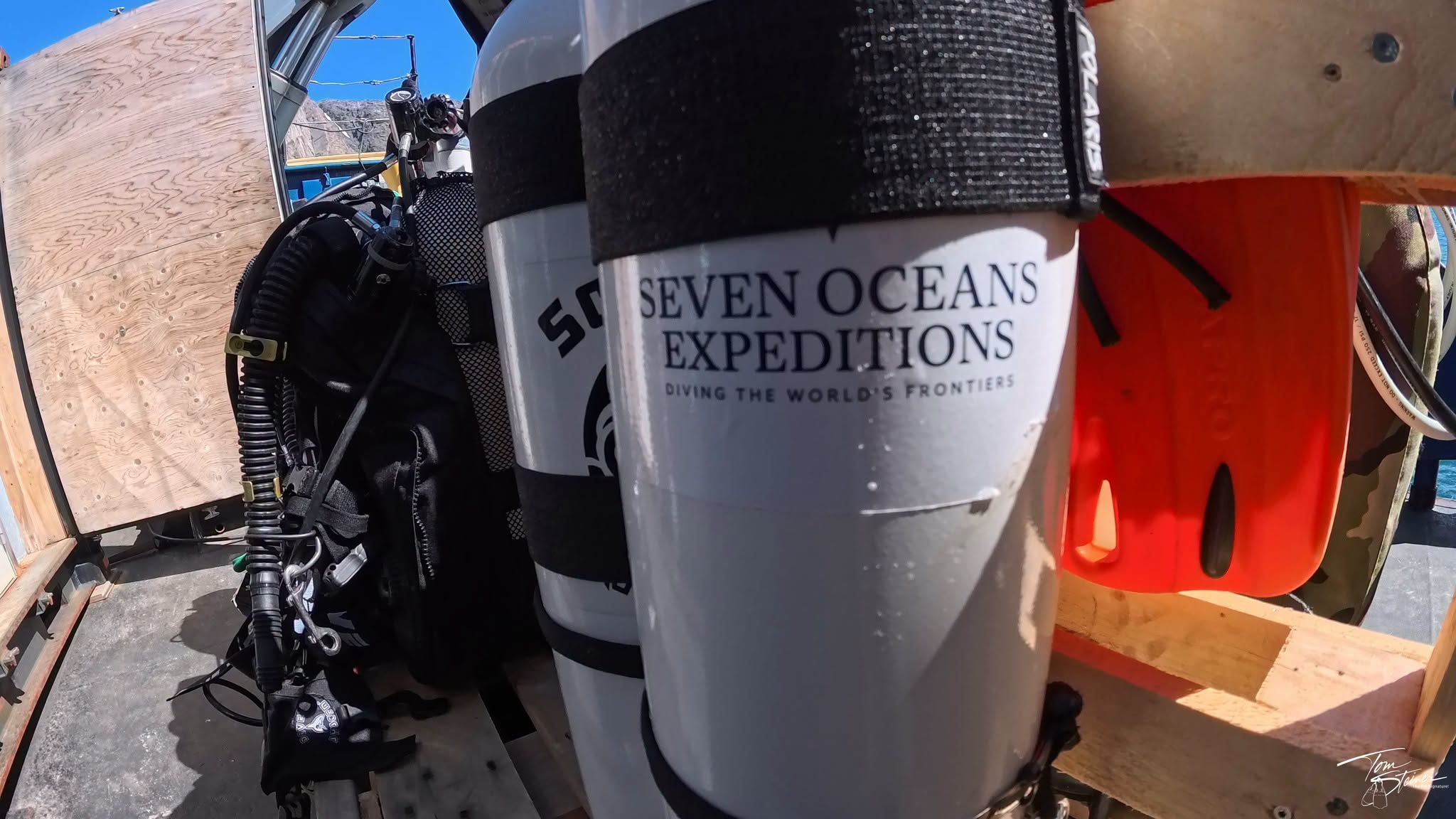
- Single-cylinder backmount. We use long 12-liter steel cylinders. Their weight sits in the right place for good trim. Each has a dual-outlet H-valve with two independent first and second stages, so it looks much like a twinset with one gas supply.
- Twinset (doubles). About half our divers choose this. Same 12-liter cylinders, with isolator manifolds and bands provided. Just bring the correct wing. You get redundant gas as well as redundant regulators, so you can handle a gas failure for yourself or a teammate.
- Sidemount. Fewer divers choose it, but we can accommodate it.
A Note on Your BC
Many divers dive a backplate and wing, some a back-inflate BCD, and some a traditional jacket BCD. All of them work, as long as your hoses are routed properly for the configuration.
If your jacket BCD has an integrated inflator and alternate second stage, such as the Scubapro AIR2 or the Atomic SS1, we strongly recommend replacing it with a standard inflator and a separate second stage. Integrated units aren’t suited to gas sharing in polar environments.
If you have questions about your setup, don’t worry. Call us and we’ll talk it through.
Why Redundancy?
Polar diving isn’t technically demanding. But in a remote place, in cold water, with less dexterity and unfamiliar muscle memory, a small problem can escalate faster. Two independent breathing systems are a sensible margin.
In summer, from June through October in Greenland, frozen or free-flowing regulators aren’t a major concern, because the air is warm even though the water is cold. In winter, when the air is cold too, regulator freezing becomes a real risk.
Use environmentally sealed regulators rated for cold water. Most modern regulators are. If you’re not sure yours are rated to 0°C (32°F), ask the manufacturer.
Service everything before you go. Have your regulators cleaned and serviced, along with any equipment that hasn’t been professionally checked recently. Then dive it once or twice before you pack it, if you’re able. Once the ship sails, you want to make sure your equipment will function well throughout the expedition. If you have old hoses, this is a good time to replace them.
Every dive follows set protocols: team diving, light signals, iceberg procedures and pre-dive checks. Our iceberg protocols are covered in detail in Volume 3, How to Safely Dive an Iceberg.
We also encourage limiting alcohol throughout the expedition, even after the day’s last dive. Staying hydrated and clear-headed keeps you ready for the next day’s diving.
To dive polar water, you don’t need technical skills or extensive training. You need the right equipment, familiarity with it and confidence in the water. If you’re learning with an instructor, they’ll judge when you’re ready.
For our Greenland expeditions, the minimum requirements are:
- Advanced Open Water or equivalent, and 150 logged dives
- At least 20 drysuit dives, comfortable with buoyancy and trim in polar undergarments with additional weight
- Prior diving in water at 9°C (48°F) or below
- Your own drysuit and cold-water equipment, and proficiency with them
Will my face freeze?
No. Your face is the only part of you that feels the cold, and for most divers the initial sensation fades within seconds to a few minutes.
Do I need an ice diver certification?
Not for our Greenland expeditions. We dive open water beside icebergs and coastlines, not under ice. An ice diver course is still excellent preparation, and you can earn one through our Polar Prep® Series or we can recommend a course.
Can I rent a drysuit?
For our expeditions, you need your own drysuit and cold-water equipment, and you need to be proficient with them. A well-fitting suit you’re familiar with is part of what keeps you warm and safe.
How cold will I actually be?
Dressed properly, most divers are comfortable for a full dive. Cold fingers and toes are the most common complaint, and adding a little gas to your suit usually takes care of it.
Polar diving can be comfortable, safe and deeply rewarding when you recognize the environment is different from what you’re used to. Even a few degrees can change how you dive and what you wear, so be familiar and confident with your gear before you go.
Dress for it, prepare for it, and an entirely new world of diving opens up.
Sources: Gerth, Ruterbusch and Long, The Influence of Thermal Exposure on Diver Susceptibility to Decompression Sickness, Navy Experimental Diving Unit TR 06-07, 2007 · U.S. Federal Aviation Administration: Airline Passengers and Batteries